
The final phase of a dissertation is often described by doctoral and postgraduate students as a “marathon within a sprint.” After months of exhaustive research and data collection, the pressure to synthesize findings into a coherent, scholarly masterpiece can feel overwhelming. In the UK, where academic standards for Level 7 and Level 8 qualifications are rigorous, the “final stretch” is where the distinction between a pass and a merit is often decided.
However, statistics suggest that the “All But Dissertation” (ABD) phenomenon is a significant hurdle. According to various UK higher education surveys, procrastination and “writer’s block” peak during the final three months of the project. To ensure you cross the finish line with your sanity and your grades intact, you need a strategy that prioritizes cognitive load management and technical precision.
If the pressure of formatting or final analysis becomes too great, many students look for professional dissertation help from experts at
myassignmenthelp. Having a second pair of eyes to ensure your work meets institutional rubrics can be the difference-maker in achieving a high-tier classification.
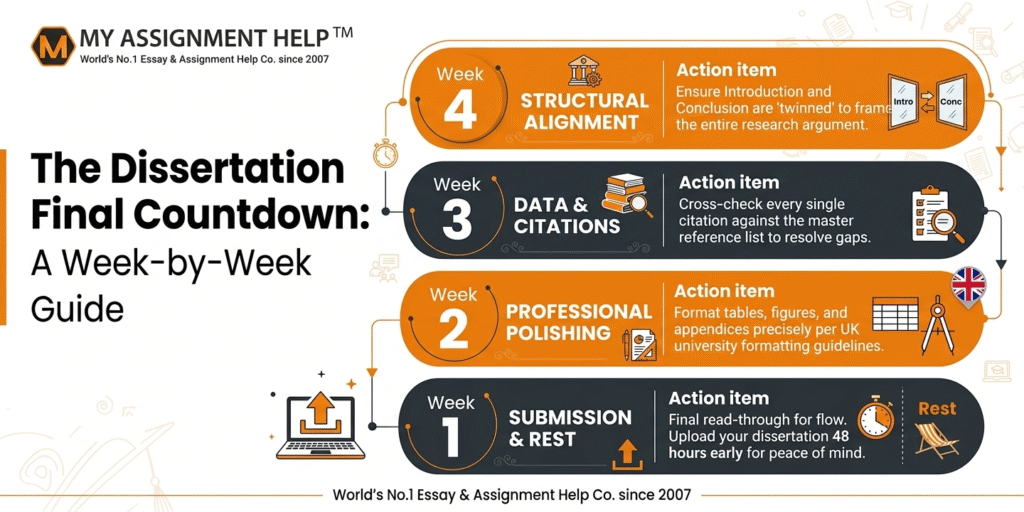
1. Reverse-Engineer Your Deadline
In the final stretch, a standard “to-do” list is insufficient. You must use backward mapping. Start with your submission date and work backward, accounting for “invisible” tasks such as technical formatting and bibliography auditing. This ensures you aren’t rushing the most critical part of the process—the final proofread.
For those managing multiple modules alongside their research, the option to
do my assignment for me through our main platform allows for a more focused approach to the dissertation itself. By offloading smaller, high-frequency tasks, you preserve the mental energy required for your primary thesis.
2. Implement the “Pomodoro on Steroids” Method
During the final stretch, burnout is your biggest enemy. Research into “Deep Work” suggests that elite cognitive performance happens in 60-90 minute bursts.
- The Strategy: Dedicate 90 minutes to a single chapter. No emails, no phone, no “quick” reference checks.
- The Data: A study by the University of London indicated that students who utilized structured “deep work” blocks reported a 30% increase in word count quality compared to those who “multitasked” with social media.
3. Focus on “Micro-Editing” vs. “Macro-Editing”
Don’t try to fix everything at once. Divide your final review into three distinct passes:
- The Logic Pass: Does the conclusion actually answer the research question posed in the introduction?
- The Citation Pass: Are all data points backed by 2024-2026 academic sources?
- The Grammar Pass: Use tools, but rely on manual reading aloud to catch clunky syntax.
4. Optimize Your Information Architecture
A dissertation isn’t just about what you know; it’s about how easily a marker can find that knowledge. Use clear, descriptive subheadings and ensure your “Signposting” is impeccable. Each paragraph should follow the PEEL (Point, Evidence, Explanation, Link) structure to maintain a logical thread throughout the document.
5. Prioritize “EEAT” in Your Discussion Chapter
The Experience, Expertise, Authoritativeness, and Trustworthiness (EEAT) framework is the gold standard for academic excellence. In your final stretch:
- Critically Evaluate: Don’t just describe your findings—challenge them.
- Acknowledge Limitations: Trustworthiness is built by being honest about what your research couldn’t cover.
- Triangulate Data: Use multiple sources (qualitative and quantitative) to support your claims.
Key Takeaways
- Deadline Decoupling: Set a personal deadline two weeks ahead of the official university date.
- Structured Deep Work: Use 90-minute blocks to avoid the “diminishing returns” of late-night cramming.
- The PEEL Method: Ensure every paragraph serves the central thesis.
- Professional Review: Utilize expert guidance to ensure your formatting meets UK standards.
FAQ Section
Q1: How do I handle writer’s block in the final 5,000 words?
A: Switch to “Non-Linear Writing.” If the Discussion chapter is stuck, move to the Bibliography or the Appendix. Movement in any section often jumpstarts the brain for the harder chapters.
Q2: Is it okay to use professional dissertation help in the UK?
A: Yes, seeking guidance for proofreading, structural editing, and data analysis is a common practice to ensure work meets the high standards of UK Higher Education (Level 7/8).
Q3: How many references should a 10,000-word dissertation have?
A: While it varies by discipline, a general rule of thumb for UK universities is 1 reference per 100-150 words, totaling roughly 70-100 high-quality sources.
Author Profile
Dr. Alistair P. Vaughan
Senior Academic Consultant at MyAssignmentHelp
Dr. Vaughan holds a PhD in Educational Psychology and has over 12 years of experience in the UK higher education sector. He specializes in helping post-graduate students navigate the complexities of thesis architecture and SEO-driven academic content. Currently, he leads the quality assurance team at MyAssignmentHelp, ensuring all student support materials adhere to strict E-E-A-T guidelines.
References
- Higher Education Statistics Agency (HESA) UK (2025). “Student Completion Rates and Trends in Post-Graduate Research.”
- Newport, C. (2016). Deep Work: Rules for Focused Success in a Distracted World.
- University of Oxford Academic Guidance (2026). “Referencing and Avoiding Plagiarism in Research.