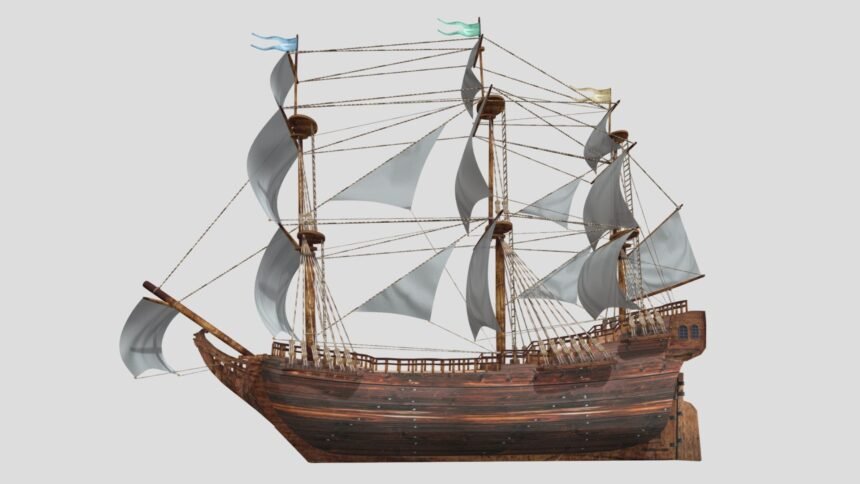
The world of Ship 3D modeling has revolutionized the way we visualize and interact with objects, environments, and machinery. Among the most complex and fascinating subjects in 3D design are ships massive, intricate structures that demand precision, creativity, and realism. The evolution of ship 3D modeling, from simple polygonal shapes to photorealistic animated vessels, tells a story of technological innovation and artistic mastery. Today, ship modeling plays a vital role across industries, including film, gaming, engineering, and virtual simulation. This article explores the fascinating journey of Ship 3D modeling from conceptual sketches to fully animated digital masterpieces.
The Early Days of Ship 3D Modeling
In the early days of computer graphics during the 1980s and 1990s, 3D modeling was a field limited by hardware and software capabilities. Ship models were often built using basic polygonal shapes with low-resolution textures. Early tools like AutoCAD, 3D Studio (now 3ds Max), and LightWave 3D enabled designers to create simple geometric representations, but the results were far from realistic. These early models were primarily used in technical applications such as naval engineering or rudimentary visual simulations. The focus was on accuracy of dimensions and structure rather than artistic appeal or surface realism. The lack of computational power restricted the number of polygons, textures, and lighting effects that could be applied.
The Shift Toward Realism
The late 1990s and early 2000s marked a major turning point in ship 3D modeling. As software and graphics hardware advanced, artists gained access to more powerful tools like Maya, Blender, Cinema 4D, and ZBrush. These programs allowed for finer detail, smoother surfaces, and more lifelike textures. With this shift, 3D ship models evolved from purely technical renderings into artistic and cinematic representations. Films such as Titanic and Master and Commander showcased breathtaking digital ships that combined live-action footage with detailed 3D models. The level of realism achieved in these productions set a new standard for the entire industry. At the same time, the gaming industry began to demand highly detailed ship models for naval combat simulations, open-world adventures, and historical strategy games. The emphasis shifted toward creating believable worlds where ships interacted dynamically with water, light, and weather.
From Idea to Digital Blueprint
Every 3D ship model begins with a concept a vision of what the vessel should look like. In the concept phase, designers gather references, create sketches, and define proportions. Depending on the project, the ship might be based on a real-world design, such as a World War II battleship, or be entirely fictional, like a futuristic spacecraft or pirate galleon. Concept artists often use 2D software tools such as Photoshop, Procreate, or Illustrator to develop the ship’s visual identity. These concept designs provide the foundation for the 3D modelers, guiding them through the shape, structure, and mood of the vessel. The concept phase is crucial because it determines the balance between realism, functionality, and artistic interpretation factors that will influence every step of the 3D modeling pipeline.

Modeling: Building the Ship’s Structure
Once the concept is finalized, the technical work begins. The 3D modeling phase involves building the digital structure of the ship from scratch using polygons, curves, and surfaces. There are two main modeling approaches: polygonal modeling and NURBS modeling. Polygonal modeling is the most common technique, ideal for hard-surface objects like hulls, decks, and mechanical parts. The artist manipulates individual polygons to create complex shapes. NURBS modeling (Non-Uniform Rational B-Splines) is used for smooth, curved surfaces such as hulls or sails, ensuring mathematical precision. Modern 3D tools allow for modular modeling, where repetitive elements like windows, rivets, or railings can be duplicated quickly. Artists often use symmetry functions to work on one side of the ship while the software mirrors their actions to the other, saving hours of work. As the model progresses, smaller components like anchors, cannons, ladders, ropes, and lifeboats are added to enhance realism. The end result is a fully detailed, untextured model the digital equivalent of a sculpted clay prototype.
Texturing: Bringing the Ship to Life
Once the structure is complete, it’s time to give the ship its color, material, and surface details through texturing. This step transforms the plain gray model into a visually captivating object. Texturing involves applying digital skins to the model, which can simulate materials such as wood, metal, rust, paint, or fabric. Key texturing techniques include UV mapping, PBR (Physically Based Rendering), and normal or bump mapping. UV mapping flattens the 3D surface into a 2D map so textures can be applied accurately. PBR simulates how light interacts with real-world materials for greater realism. Normal and bump maps add surface depth and fine details like scratches, rivets, or corrosion without increasing the polygon count. Programs like Substance Painter, Mari, or Quixel Mixer are commonly used to paint and refine textures. For ship models, texture artists often study real-life reference photos of metal hulls, weathered wood, and ocean effects to ensure authenticity.
Lighting and Rendering: Achieving Realism
Lighting is one of the most critical aspects of making a 3D ship model look believable. Realistic lighting can transform a digital model into what appears to be a real ship sailing on the ocean. Using rendering engines like Cycles (Blender), Arnold (Maya), or V-Ray, artists simulate natural light sources such as sunlight, moonlight, and reflections on the water’s surface. Shadows, reflections, and refractions are carefully adjusted to match real-world behavior. Once the lighting setup is finalized, the model undergoes rendering the process of converting the 3D scene into a 2D image or animation. This process can take minutes or even hours per frame, depending on the complexity of materials and lighting effects. High-quality rendering often requires powerful GPUs or cloud-based rendering farms.
Animation: Bringing Motion to the Model
A static 3D model, no matter how realistic, becomes truly captivating only when it moves. The animation phase adds life and motion to the ship. Animators may simulate ocean movement using dynamic water simulations to create realistic waves and splashes. Ship motion is designed to mimic how a ship rolls, pitches, and sways with the sea. Wind effects adjust sails, ropes, and flags based on virtual wind dynamics, while mechanical motion brings rotating propellers and turning rudders to life. Programs like Houdini, Blender, and Unreal Engine can simulate physics-based interactions between the ship and its environment. When combined with advanced particle systems for spray, smoke, and weather, the animation achieves a breathtaking level of realism.
Applications of Ship 3D Modeling
Today, ship 3D modeling extends far beyond the entertainment industry. It serves multiple professional and creative fields. In film and television, it is used for visual effects, historical reconstructions, and science fiction scenes. In video games, it enables interactive gameplay in naval battles, exploration games, and simulations. In maritime engineering, it assists shipbuilders in visualizing and testing designs before construction. In virtual reality and training, it allows immersive simulations for navigation or naval education. In art and education, it provides digital replicas of historic ships for museums and documentaries. These applications show how 3D modeling bridges the gap between creativity and functionality.
The Role of AI and Modern Technology
Artificial intelligence and automation are now reshaping the future of 3D modeling. AI-powered tools can generate ship geometries, apply automatic texturing, and even simulate realistic ocean environments in real time. For example, procedural modeling allows artists to build complex ship details algorithmically, drastically reducing manual labor. Meanwhile, real-time rendering engines like Unreal Engine 5 enable designers to see instant visual feedback, making adjustments faster and more efficient. The integration of virtual reality (VR) and augmented reality (AR) takes ship visualization to new heights. Designers can walk virtually on their digital ships, inspect details, and even test ergonomics before any physical prototype is built.
The Future of Ship 3D Modeling
As technology continues to evolve, Ship 3D modeling will become even more immersive, efficient, and accessible. Real-time rendering, cloud collaboration, and AI-driven design tools are transforming how ships are created and visualized. In the near future, we can expect hyper-realistic digital twins of real-world ships that mirror every detail, from structural integrity to ocean behavior. These digital ships will not only be used for entertainment but also for training, engineering, and maritime research. The boundary between real and digital will continue to blur and ship 3D modeling will remain at the forefront of this transformation.
Conclusion: A Journey of Art and Technology
The evolution of ship 3D modeling reflects the perfect blend of art, science, and innovation. From the early polygonal designs of the 1980s to the cinematic, animated masterpieces of today, the process has come a long way. What began as a technical necessity has grown into an artistic discipline capable of bringing the vastness of the sea and the complexity of human engineering to life. As technology advances, ship 3D modeling will continue to evolve turning imagination into digital reality, one polygon at a time.